Programme
18:30 Drinks and meal
19:30 Post-earthquake documentation, damage assessment and evaluation of Antakya’s multi-layered cultural heritage by Pınar Aykaç, A. Güliz Bilgin Altınöz, Özgün Özçakır, Sibel Yıldırım Esen
20:15 Break
20:30 Debate with the audience
21:15 End

Antioch's Post-Earthquake Recovery
As we are used to, this evening will be preceded by informal drinks and a simple meal.
Unlike the online lectures, we have a limited capacity for attendance. We can only accommodate 30 people. For that reason we ask you to register in advance for attendance. Please use the register form through this link. Here you can also register for the preceding drinks and meal.
Unlike the online lectures we have to charge an attendance fee to cover costs. Attendance is EURO 5,- (be it, only for non-members; for ICOMOS-members attendance is free of charge). If you join the preceding drinks and meal, you are charged EURO 15,-. All payments can only be done by bank transfer on the spot.
(Please consider that a no-show on a registered meal will burden ICOMOS’s limited resources)
This month’s lecture evening we will welcome the Turkish delegation from Ankara’s Middle East Technical University. They are currently visiting the Netherlands for a comparative analyses on heritage conservation, supported by the Centre for Global Heritage and Development. Our guests will share their experiences in the efforts made in recovering the legendary city of Atioch after the earthquake earlier this year.
About the lectures
Post-earthquake documentation, damage assessment and evaluation of Antakya’s multi-layered cultural heritage in Hatay, Turkey
Guest speakers: Pınar Aykaç, A. Güliz Bilgin Altınöz, Özgün Özçakır, Sibel Yıldırım Esen
Antakya, or Antioch, the city founded in 300 BCE to be the capital of Seleucids, is located in the southeast of Turkey. Antakya hosts many monumental and residential structures belonging to different periods. The multi-layered urban tissue, mainly consisting of 19th century Ottoman architecture alongside buildings influenced by French architecture during the French Mandate period, co-exist with the archaeological remains underneath. The urban tissue in the historic core is the continuation of the city's life since its foundation. With its long and diverse history. Antakya has significant cultural value both architecturally, artistically, and historically.
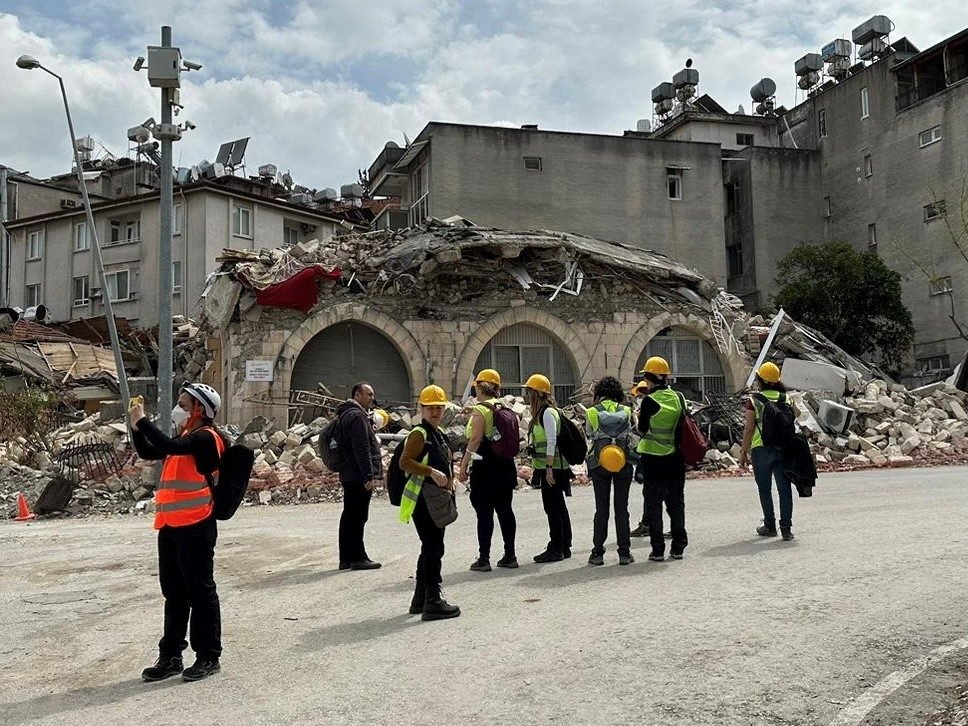
The Kahramanmaraş-centered quakes on February 6, 2023, measuring 7.7 and 7.6 Mw as well as another earthquake with a magnitude of 6.4 centered in Samandağ-Hatay on February 20, 2023, caused great destruction and damage to the historical city center of Antakya, which stands out for its historical stratification and continuity, and cultural richness. The earthquakes resulted in one of the most significant regional disasters in the area in over a century. Many cultural heritage buildings have been ruined or severely damaged. The evaluate the post-earthquake damage is as relevant as urgent, now that many heritage buildings have become even more fragile.
To respond to the challenges that Antakya's multi-layered cultural heritage faces following the earthquakes, METU Centre for Research and Assessment of Historical Environment (METU TAÇDAM) and METU Graduate Program in Conservation of Cultural Heritage (METU CONS) initiated a multi-disciplinary project for the post-earthquake damage assessment, emergency response, conservation, rehabilitation and resilience of cultural heritage assets in Antakya’s historical city center.
The presentation aims at introducing the project that the team conducts in collaboration with non-governmental organizations and local authorities. The speakers will first present the project's methodology for the post-earthquake damage assessment in Antakya and then further elaborate on the post-earthquake situation of Antakya's multi-layered cultural heritage based on their studies in the field. Afterwards, the post-earthquake situation of Antakya's cultural heritage will be evaluated, and the project team’s preliminary findings on the possible intervention principles and strategies for post-earthquake recovery of Antakya will be shared with the audience.
About the speakers
Pınar Aykaç is an associate professor at the Middle East Technical University’s Department of Architecture in Ankara, Turkey. She received a MSc in the Conservation of Cultural Heritage from Middle East Technical University, and a PhD from UCL, the Bartlett School of Architecture. Her research interests include the relationship between heritage sites and museums, heritage politics and contestations, and the interpretation and presentation of heritage places. She is the author of Sultanahmet, Istanbul’s Historic Peninsula: Musealization and Urban Conservation (Lexington Books, 2022) and the co-editor of Architectures of Emergency in Turkey: Heritage, Displacement and Catastrophe (I.B. Tauris, 2021) together with Eray Çaylı and Sevcan Ercan. She is currently one of the co-editors of Heritage & Society Journal.
A. Güliz Bilgin Altınöz is a professor in cultural heritage conservation at the Middle East Technical University Department of Architecture. She is the Chair of the Graduate Program in Conservation of Cultural Heritage, the Director of the METU Centre of Research and Assessment of Historical Environments [TAÇDAM], and the Director of the METU Archaeology Museum. She is the co-editor of the Turkish Academy of Sciences Journal of Cultural Inventory [TÜBA-KED]. She is a member of the ICOMOS-Turkey National Committee's Executive Board and the Expertise Committee on Tangible Cultural Heritage of the Turkish National Commission for UNESCO.
Her main academic and professional interest areas are theory and criticism in heritage studies; conservation, management, and planning of heritage places; multi-layered towns and urban archaeology; heritage information management and decision support systems; heritage risk assessment and adaptation to climate change. She supervised thesis, conducted and participated in various national and international projects, and published articles and book chapters on these subjects.
Özgün Özçakır is an architect by training who is specialized in the preservation field. He received his Ph.D. degree from the Graduate Program in Conservation of Cultural Heritage of METU for his thesis entitled ‘In-Between Preservation and Economics: Establishing Common Ground between Socio-Cultural and Economic for the Sustainability of Urban Heritage Places in Turkey.’ He has attended international meetings as a speaker, including those organized by the Association of Critical Heritage Studies, the Association of Cultural Economics International, BTU Cottbus, Columbia GSAPP and TU Delft. He is a member of ICOMOS Turkey, and ICOMOS SDGs Working Group. He is an assistant professor at Middle East Technical University, Department of Architecture and his research interests include heritage values, heritage and sustainability, heritage impact assessment (HIA), approaches and strategies for intervention in heritage places.
Sibel Yıldırım Esen is an Assistant Professor at the Department of Architecture at Middle East Technical University (METU) in Turkey, with more than twenty years of experience in architectural design and cultural heritage conservation. She received her PhD in Architecture from METU and also holds a MArch. and an MSc. in Restoration degree from the same institution. Her research focuses on risk assessment and management of cultural heritage, heritage risk governance, as well as the role of cultural heritage in building resilience. Dr Esen's PhD dissertation was awarded the METU Best Thesis Award and proposed a new territorial-scale risk assessment methodology for archaeological sites that are exposed to natural, institutional and individual-caused hazards. In addition to her academic experiences, she worked at the Ministry of Culture and Tourism for over ten years, where she coordinated large-scale architectural conservation projects for heritage sites such as the World Heritage Divrigi Great Mosque and Hospital Complex. In 2015, she carried out postdoctoral research at the International Centre for the Study of the Preservation and Restoration of Cultural Property (ICCROM) in Rome. Dr Esen is an expert member of the ICOMOS International Scientific Committee on Risk Preparedness (ICORP).