Using new technologies in archaeology: case studies from the UK, Iraq and Syria
Lezing
Dear heritage colleagues and friends,
We kindly invite you to the upcoming ICOMOS Netherlands lecture evening on Wednesday 8 March 'Using new technologies in archaeology: case studies from the UK, Iraq and Syria'.
Archaeologists increasingly make use of new technologies such as CT scanning, 3D-scanning, LiDar (Airborne Laser Scanning) and deep learning, that make it easier to detect and preserve heritage, even from a distance. In this lecture, the speakers will present different case studies from the UK, Iraq and Syria. Iris Kramer (ArchAI) has developed a technology to research historical land management. She worked with two partners in the UK to digitise ridge and furrow traces and to map historical woodland and orchards. Dominique Ngan-Tillard and Rients de Boer (both from Delft University of Technology and the Centre for Gobal Heritage and Development) will explain the use of modern techniques to preserve looted clay tablets from Iraq and Syria and to unlock non-textual information.
Anna Louwerse, Ankie Petersen, Ardjuna Candotti, Daan Lavies, Jacomine Hendrikse, Jean-Paul Corten, Maurits van Putten and Remco Vermeulen.
Programme
19:30 Opening by Jacomine Hendrikse
19:35 Using deep learning to inform schemes designed for sustainable land management in the UK by Iris Kramer
20:00 Short Q&A
20:05 Break
20:15 The benefit of modern techniques to study and safeguard ancient cuneiform tablets from Iraq and Syria by Dominique Ngan-Tillard and Rients de Boer
20:40 Q&A
21:00 End
About the lectures
Using deep learning to inform schemes designed for sustainable land management in the UK
By Iris Kramer
Deep learning is novel technology that can be used to automatically detect archaeology through training an Artificial Intelligence-model on human expert labels. ArchAI’s technology is based on Iris' PhD research that was able to discover over a hundred new archaeological sites from LiDAR on the Isle of Arran in Scotland. In this talk, Iris will focus on ArchAI's latest projects and how they can be used to inform schemes designed for sustainable land management. The first case study is a project for the UK Forestry Commission focused on digitising ridge and furrow on LiDAR, classifying these by date and assessing the preservation based on the height of ridges. The second case study, in collaboration with the British National Trust, focused on biodiversity assessment from historic OS mapping from early 1900 by digitising various woodland and orchard symbols.
The benefit of modern techniques to study and safeguard ancient cuneiform tablets from Iraq and Syria
By Dominique Ngan-Tilland and Rients de Boer
Cuneiform script was used in the Middle East between ca. 3300 BCE and 300 CE. People wrote cuneiform not on paper, but on clay tablets, many of these tablets survive up to the present day. However, due to armed conflicts, they have also been looted by the thousands from Iraq and Syria since the 1990s. This presentation focuses on the textual and historical side of how modern techniques can help to study and preserve these documents written in Antiquity. It will also explain how the same techniques unlock the non-textual information contained in cuneiform clay tablets and reveal a wealth of information about the ancient human and natural environment.
About the speakers
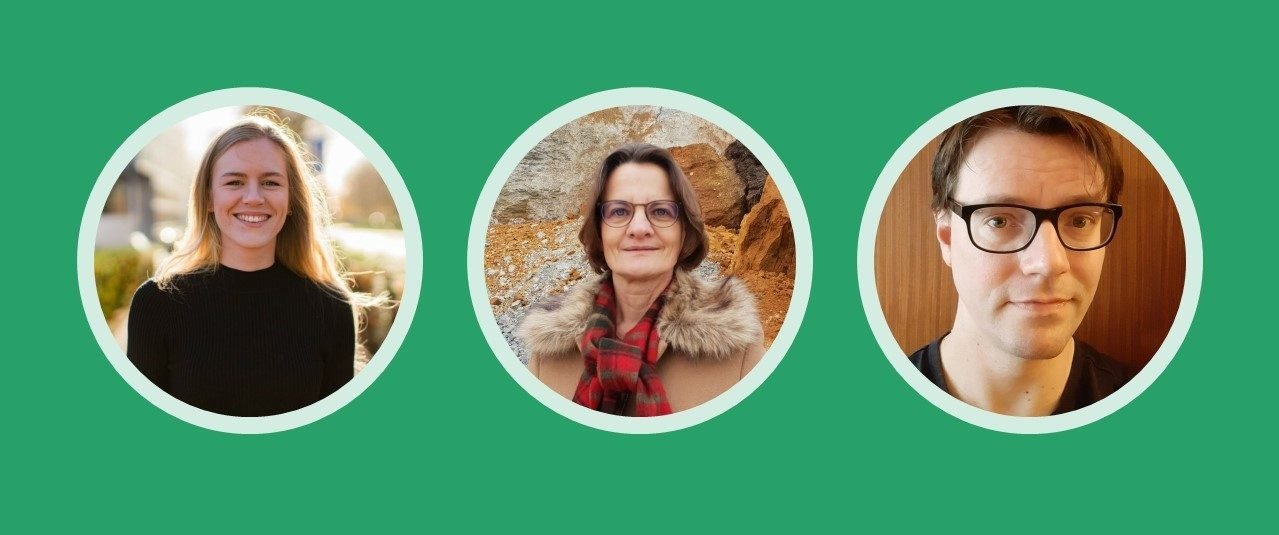
Iris Kramer graduated with a BA in Archaeology from the University of Leiden, an MSc in Archaeological Computing at the University of Southampton, and a PhD in the Electronics and Computer Science department at The University of Southampton. Iris has a wide range of skills from archaeology, web development, computer vision, AI, geospatial analysis and processing of earth observation data. She has pioneered the use of deep learning for the detection of archaeological sites and presented her research at numerous conferences.
Iris founded ArchAI in the final year of her PhD and has acquired several grants (including the Royal Academy of Engineering and the ESA) and several commercial contracts for large scale and national projects. Iris has also been named on the 2022 Forbes 30 under 30 list of Science and Healthcare for pioneering ground-breaking technology.
Dominique Ngan-Tillard is an Applied Earth scientist, educated in geophysics and geomechanics. She is assistant professor at Delft University of Technology in the department of Geoscience and Engineering. Dominique is also research coordinator of HUT, the Heritage Under Threat group of the Centre for Global Heritage and Development created by the Universities of Leiden, Erasmus and Delft. She is specialized in non-destructive testing of geomaterials and applies her expertise to a large variety of archeological soils and artefacts.
With her project Scanning for Syria, Dominique produced replicas of tablets looted in Syria and received a Europa Nostra award in 2020. Dominique was also the first to open digitally an encased tablet, reveal text hidden for more than 4000 years, and image in 3D non textual information embedded in the tablet.
Rients de Boer studied Assyriology in Groningen, Leiden and Paris. He received his PhD in 2014 with a study on the Amorites. After this, he was a lecturer in Ancient Studies at the Vrije Universiteit Amsterdam. Rients currently works for the Centre for Global Heritage and Development created by the Universities of Leiden, Erasmus and Delft. He also is a researcher on WW2 heritage at Delft University of Technology.